



Artificial intelligence has become a core driver of U.S. innovation, and is increasingly treated as part of the nation’s critical infrastructure. Its impact spans economic growth and productivity, national security and technological leadership, and the modernization and automation of many core industries.
The rapid adoption of AI has already increased productivity across industries and sparked a surge in both private and public infrastructure investment, particularly in large-scale AI factories and hyperscale cloud data centers.
These AI-focused data centers are significantly larger and more power-intensive than traditional, general-purpose data centers and require continuous, highly reliable power. As a result, the energy and AI sectors have become tightly intertwined in a shared effort to address this need. The next era of AI demands an energy supply chain, from generation through delivery, that can scale securely, reliably, and efficiently to support rapid AI growth while preserving grid stability, power affordability, and national resilience.
How AI Factories Are Powered
Across most major AI factory projects under development, natural gas remains the dominant source of power. While many projects draw from a diverse mix of energy sources, including wind, solar, nuclear, and hydroelectric power, renewable generation is often intermittent. To ensure continuous and reliable operation, these sources are typically paired with dispatchable power generation, most commonly natural gas, which serves as the primary backbone of AI power infrastructure.
AI factories are powered in two primary ways. Some facilities rely on the existing electrical grid and its available generation resources. Others are built alongside co-located power generation, commonly referred to as behind-the-meter (BTM) power, which eliminates the need to transport electricity across the grid. In this model, power is generated and consumed locally, creating a tighter coupling between energy production and AI infrastructure. Co-located generation provides AI factories with a dedicated and reliable power source while reducing dependence on grid capacity and mitigating concerns related to reliability, congestion, and the risk of rising energy costs for consumers and businesses.
Independent Power Producers (IPPs) are assuming a more prominent role in this new energy landscape, both as BTM power suppliers, and as suppliers of new capacity to the conventional electric grid. With the proliferation of IPP build-outs, the energy supply chain is growing more complex, and new protections are required to ensure resiliency, both for AI factories and for the grid as a whole.
Understanding the Energy Supply Chain
To understand the implications of powering AI at scale, it is useful to examine the energy supply chain, using natural gas as an example. Any disruption across this chain can have cascading effects on power generation and AI operations.
The natural gas supply chain includes:
- Upstream exploration and production
- Midstream transmission and storage
- Downstream distribution to end users
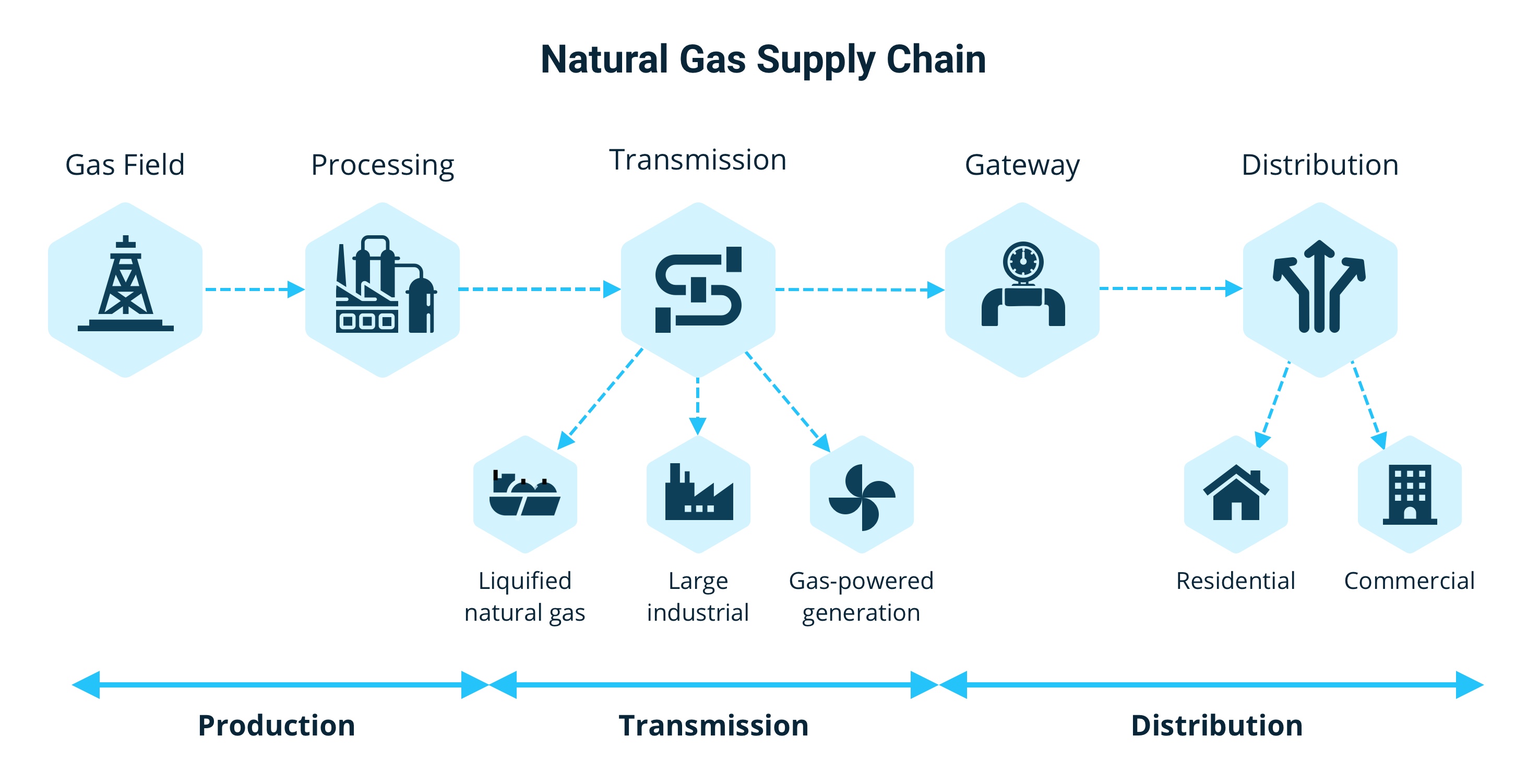
In the BTM model, the final downstream distribution step is eliminated, reducing complexity in last-mile power delivery. In some large-scale BTM deployments, power generation and AI factory operations are so tightly integrated that they function almost as a single system. However, even with this final step removed, upstream and midstream infrastructure remain critical, and vulnerabilities in those segments can still directly affect AI operations. Because each layer depends on the resilience of the others, resilience must be addressed end-to-end through a unified approach across the entire environment.
Resilience and Security Challenges in the Energy Supply Chain
As energy demand grows to support AI infrastructure, the resilience and security of the energy supply chain become increasingly critical—not only to keep AI factories online, but also to ensure uninterrupted service for residential and commercial customers.
Much of the infrastructure that controls and operates today’s energy supply chain consists of assets that are decades old and were not designed for modern connectivity or today’s cybersecurity threat landscape. As these systems are modernized or brought online, they can be difficult to secure.
Still, security risk is not limited to legacy systems alone. Even modern facilities with newer infrastructure, including those built under the BTM model, can become centralized points of failure if they are not properly designed, deployed, and protected. As a result, resilience depends not only on upgrading older assets, but on securing diverse systems in a way that avoids systemic risk.
Managing third-party and vendor access is another significant challenge for the resilience of the energy supply chain. Energy operators routinely rely on external parties to service and maintain critical systems. If these third-parties are granted overly permissive remote access, they can introduce significant risk across the supply chain. Enforcing restricted, role-based access that limits exposure without disrupting operations is essential.
Xage addresses these challenges by securing every step of the energy supply chain. Today, Xage protects approximately 60 percent of all midstream pipeline infrastructure in the United States; works with utilities nationwide to ensure the secure and safe delivery of power to homes and businesses; and partners with major global energy producers and operators, including Kinder Morgan, PETRONAS, Petrobras, and others worldwide.
Increasingly, operators across the energy supply chain are also deploying AI to optimize power generation and delivery for AI data centers in real time—an emerging field in “AI for Energy” where digital intelligence directly shapes physical infrastructure and operational outcomes. While these capabilities can unlock major gains in efficiency and reliability, they also introduce new security requirements, as AI-driven systems become tightly coupled with critical energy operations. This is where Xage and NVIDIA have collaborated to deliver a fully distributed, identity-based, Zero Trust protection at scale, securing both AI factories and the critical infrastructure that powers them.
For a deeper look at how AI is also transforming operational technology (OT) cybersecurity — including how NVIDIA and Xage Security are applying AI to protect critical infrastructure like energy and industrial control systems — see NVIDIA Brings AI-Powered Cybersecurity to World’s Critical Infrastructure.
Securing the AI Factory
The same security challenges present in the energy supply chain—diverse assets, third-party access, and operational complexity—also apply within the AI facilities themselves. However, they introduce additional and unique security requirements as well.
AI factories combine accelerated computing systems, specialized AI workloads, and cyber-physical infrastructure such as power distribution, cooling systems, and building management platforms. These environments operate at unprecedented scale and speed, requiring security controls that can keep up without degrading performance.
AI workloads require identity-based, Zero Trust enforcement for both human and AI entities at AI scale. The Xage and NVIDIA solution delivers Zero Trust security that scales and operates at line rate to protect AI factories. With this approach, AI workloads and data pipelines are properly isolated, threats are contained, and lateral movement and unauthorized access is prevented.
Running the Xage’s security controls on NVIDIA BlueField data processing units (DPUs) provides full visibility into the state of AI workloads while offloading security processing from CPUs and GPUs, maximizing AI performance. The integrated solution delivers ultra-high throughput security at AI scale, supporting up to 10 million assets and 50 million simultaneous interactions, operating at line rate with throughput up to 400 Gbps and Zero Trust enforcement up to 100 times faster than software-only approaches.
To learn more about the Xage and NVIDIA solution, read our solution brief.
Ideally, Zero Trust is applied to the AI factory through a unified, full-stack approach that spans power systems, AI computing infrastructure, and all physical and digital resources in between. This unified model simplifies security by reducing operational complexity, minimizing the risk of configuration errors, and eliminating the vulnerabilities that often emerge at the seams between disconnected security controls.
Conclusion
The rapid expansion of AI is fundamentally tied to the energy systems that power it. Ensuring the success of AI factories requires reliable and resilient energy supply chains, secure integration of IT, OT, and AI systems, and protection that spans from energy production to AI data center operations.
Securing the energy supply chain and the AI factories it powers is essential to sustaining AI-driven growth. Xage is working with global organizations in the energy, utility, and AI industries to provide this protection end-to-end.
Visit Xage at S4x26
Heading to S4x26 security conference? Stop by the Xage booth in the POC Pavilion to see live demonstrations of the Xage platform, including our NVIDIA integration. Learn how we’re helping organizations secure and scale zero trust access across IT, OT, and edge environments.